
 USE CASES
Your customers do not compare your order page with other WooCommerce stores. They compare it with the last order page they used, and statistically that was a marketplace.
This is not an argument that you should be Amazon. It is an argument that the expectation exists whether or not it is fair, and that it is worth knowing exactly what you are being measured against.
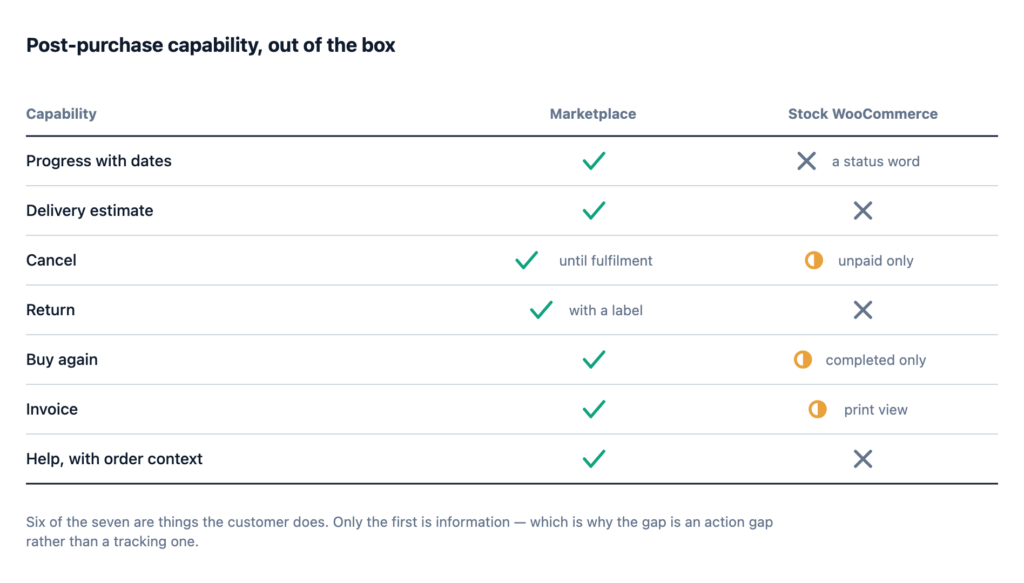
Open Your Orders and each order carries roughly seven affordances:
Six of the seven are things the customer does. Only the first is information.
A status word, a total, and a View button. On the order itself: the items, the addresses, and nothing to press.
To be precise, because core does more than it gets credit for: there is a Cancel link on pending and failed orders, and an “Order again” button on completed ones. Both are real and both are narrow enough that most customers never see either. There is also a [woocommerce_order_tracking] shortcode for guests, if you have put it on a page.
Not because WooCommerce is deficient. Because of arithmetic.
A marketplace amortises the cost of building a returns flow across hundreds of millions of orders. The per-order cost of that engineering rounds to zero, and the saving in support contacts is measured in thousands of staff. It is not a feature decision; it is an obvious investment at that scale.
WooCommerce is a platform for a very wide range of stores, from a hobby shop to a large retailer. Building an opinionated returns workflow into core would impose one company’s operational assumptions on all of them. So core ships the primitives — statuses, hooks, an actions filter, order CRUD — and leaves the workflow to extensions. That is a defensible design, and it is why the gap is real without anyone having made a mistake.
The consequence for you is that closing the gap is a purchasing and integration decision rather than a settings one. Assembling the stack that covers all five categories is a real exercise with a real cost, and worth pricing before starting.
Not all of them. Here is the honest ranking for an independent store.
The highest-value item on the list, because it is the question customers ask most and the one you can answer entirely from your own data. A date range from handling and transit time requires no carrier integration at all.
The most urgent gap, and the one core leaves most conspicuously open. With one difference: Amazon can auto-cancel because its systems know exactly where an order is in fulfilment. Yours do not, which is why a request-and-approve flow is the right shape for an independent store rather than a straight copy of the marketplace behaviour.
Cheap and consistently underrated. A message form that already knows the order number, the status and the items removes an entire round trip from every conversation it starts. Compared to a generic contact page it is a small change with a disproportionate effect on how long each thread runs.
And this is where the copying should stop for most stores.
Buy Again is enormous for Amazon because a large share of its catalogue is things that run out — batteries, nappies, coffee, cables. The button matches the shopping behaviour.
If you sell a $400 piece of furniture, or a wedding ring, or a wetsuit, nobody is buying it again. A Buy Again button on that store is not a small win, it is a dead control that makes the page busier. Look at your own repeat-purchase rate before you build it — the case where it genuinely pays is specific and easy to check against your own data.
Not at first, anyway. The visible part is a form; the invisible part is a carrier account, label generation, per-country rules and a warehouse process for matching returned parcels to requests. A manual returns workflow with clear instructions handles the same volume for a fraction of the effort, and you will understand your own returns much better before you automate them.
Amazon cancels and returns at the item level because its orders are large and multi-vendor. If your average order is one or two lines, whole-order cancellation covers nearly every case, and item-level adds a lot of interface for a small number of orders. Returns are the exception — partial returns are common at any order size.
Parity is not the goal and is not achievable. A sensible destination for an independent store is:
That is six of the seven, most of the value, and none of the carrier integration.
And one thing you have that the marketplace does not: the customer knows they bought from you. A well-handled cancellation from a small store is a relationship. From a marketplace it is a transaction with a policy engine. That is worth more than the feature checklist, and it is only true if somebody actually answers.