
 PLUGIN COMPARISON
Comparisons between these two platforms usually turn into a values argument. This one is narrow on purpose: what a customer can see and do after they have paid, with no apps and no plugins installed.
On that specific question, Shopify wins, and it is worth understanding exactly why before deciding whether it matters.
Shopify’s customer accounts give a shopper their order history, order status, and a route back into buying the same things again, without the merchant installing anything. Self-serve returns and cancellations are available to merchants as native functionality rather than as a purchase decision.
WooCommerce ships an orders table with a status word and a View button. Also, and to be fair to it: a cancel link on pending and failed orders, an “Order again” button on completed ones for logged-in customers, and a [woocommerce_order_tracking] shortcode you can put on a page for guests. Real, and narrow.
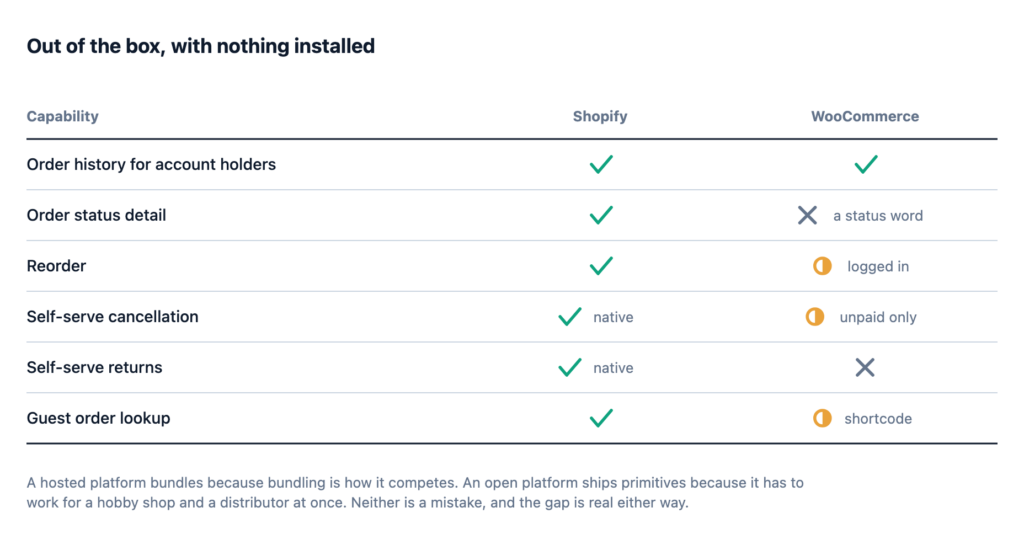
It is a consequence of the business models, not of one team caring more.
A hosted platform owns the whole stack and takes a share of every transaction. Building post-purchase self-service into the platform reduces support load across every merchant at once, and improving merchant retention is directly worth money. It bundles, because bundling is how it competes.
An open platform runs on your server, takes nothing per transaction, and has to work for a hobby shop, a B2B distributor and a large retailer at once. Building an opinionated returns workflow into core would impose one operational model on all of them, so core ships primitives — statuses, order CRUD, an actions filter, hooks — and leaves the workflow to extensions.
Neither is a mistake. They are different answers to who decides how your store works.
Shopify wins on day one. A new merchant gets a competent post-purchase experience without evaluating anything. For someone who does not want to make software decisions, that is worth a lot, and dismissing it is a mistake WooCommerce advocates make regularly.
WooCommerce wins on ceiling. Native features are as far as the platform’s design goes. On WooCommerce, everything above is a plugin, a hook or an afternoon of code. If your returns process is unusual — B2B approvals, per-category rules, an ERP handoff — the open platform is where that is buildable rather than negotiable.
WooCommerce wins on the per-transaction cut, which grows with you in a way a plugin licence does not.
Shopify wins on maintenance. Native features do not conflict with your theme, do not need update testing, and cannot be abandoned by their developer. The five-plugin stack has real costs that do not appear on any invoice, and this is where they land.
If you are choosing a platform today and post-purchase self-service is your top priority with no other requirements, that combination points at Shopify. That is not a comfortable sentence on a WooCommerce blog, and it is the accurate one.
There is a useful second-order observation here, and it explains something about the app ecosystems.
A post-purchase app on Shopify competes with functionality the platform already provides. The gap it fills is narrow — polish, branding, analytics on top of something that already works. That is a hard sell, and it is a reasonable explanation for why post-purchase apps on that platform have often struggled to find an audience.
The same product on WooCommerce fills a much larger gap, because the baseline is a status word and a View button. So the fact that an idea did poorly on Shopify is weak evidence about WooCommerce, in either direction — the two markets have different baselines and the comparison does not transfer.
Which is also a reason to be sceptical of “Shopify has this and you do not” as a sales argument, including when we make it. The right question is not what another platform ships. It is what is actually in your inbox.
“Shopify does returns, WooCommerce does not.” Nearly true and misleading. Both platforms end up needing a returns process that fits how you actually work; one starts you with a default and the other starts you with a decision. On a store with an unusual returns policy the default is something you fight rather than something you use.
“WooCommerce is free.” The software is. A post-purchase experience comparable to the hosted default is a handful of plugins, some of them paid, plus the time to keep them working together. Compare like with like: the platform fee against the plugin stack plus maintenance, not against zero.
“You can just build it.” You can, and the parts that are genuinely quick are the parts core already has hooks for — adding an action to the orders table is an afternoon. The parts that take real time are the ones nobody scopes: ownership checks for guests, rate limiting, nocache headers, business-day arithmetic across timezones, and a queue somebody will actually work from.
One practical note for anyone moving stores, in either direction: order history does not transfer cleanly, and post-purchase features are the first place customers notice.
Imported orders arrive without the status-change history that a timeline needs, because WooCommerce stores only four dates per order and an import gives you fewer than that. Plan for old orders showing a stage without a timestamp, or no timeline at all, and decide which before a customer asks. The same applies to any tracking numbers that did not come across — a tracking display populated for new orders and blank for old ones reads as broken rather than as a migration artefact.
For a WooCommerce store, the practical shopping list is short:
Six items. Two of them are core settings and a filter. The rest is a plugin decision or a few days of work.
Feature parity is not the goal, and treating it as one leads stores to build things nobody uses.
The customer does not know which platform you are on. They know whether they could find out where their order was, and whether cancelling it was possible. If your inbox is entirely “where is it”, a delivery estimate and a timeline get you most of the way there, and you can ignore the rest of the list indefinitely.
Migrating platforms to get post-purchase features is almost never the right trade. Migrating is expensive, risky, and touches everything. Closing this specific gap on WooCommerce is a plugin decision and a couple of settings.