
 USE CASES
WISMO — “where is my order” — is the most-cited statistic in post-purchase software marketing. You will have seen the range: something like a quarter to two fifths of all support contacts.
Before you build a business case on that number, it is worth asking who it describes. Because it is probably not you.
The widely-quoted WISMO percentages come from enterprise retail and large direct-to-consumer operations, usually published by vendors selling post-purchase tooling into that market. That does not make them wrong. It makes them a description of a specific kind of store: high order volume, a dedicated support team, a ticketing system that categorises contacts, and enough scale that a percentage point is a salary.
A WooCommerce store doing four hundred orders a month is a different animal. Support is one person who also does the packing. There is no ticket taxonomy, because there are no tickets — there is an inbox. And thirty percent of a small number is still a small number.
So do not adopt somebody else’s percentage. Measure your own. It takes an afternoon and the answer is more useful than any benchmark.
Four numbers, three of which you can get from your own inbox in an hour.
| Input | Where it comes from |
|---|---|
| Orders per month | WooCommerce → Analytics → Orders |
| Customer emails per month | Count a month in your inbox |
| Share of those that are “where is it” | Read them and tally |
| Minutes to handle one | Time yourself on ten |
Then:
WISMO emails per month  = emails per month x WISMO share
Hours per month         = WISMO emails x minutes each / 60
Cost per month          = hours x what an hour of your time is worth
The fourth input is the one people get wrong in both directions. It is not just the two minutes of typing. It is the context switch out of whatever you were doing, opening the order, checking the courier’s site, writing the reply, and the second email when your answer was not specific enough. If you time it honestly, the number is usually four to six minutes, not two.
Two stores can run this and get very different answers, and both answers can be correct.
Same feature, completely different business case. Do the count before you decide.
Here is the counter-intuitive part. The stores that get the most WISMO email are usually not the ones that tell customers nothing. They are the ones that tell customers something useless.
“Your order is processing” and “delivery in 5–10 business days” are both technically informative and practically not. The customer cannot tell from either whether their order is progressing normally or has been forgotten. Having no way to answer their own question, they ask you.
Shoppers now compare every purchase against the marketplaces, where a specific delivery date is standard. Against that, a ten-day window does not read as an estimate. It reads as an absence of information. The gap between what a marketplace order page shows and what a WooCommerce one does is worth looking at directly, because it is what your customers are unconsciously comparing you to.
The practical consequence: a store with a five-day window and a specific date usually gets less WISMO email than a store with a three-day window and a vague one. Precision beats speed.
The order confirmation is the most-opened message you send. If it says “arrives between the 26th and the 28th” instead of “5–10 business days”, a share of the questions never get asked. Working out that range from handling time and transit time needs no carrier integration and no plugin — the calendar arithmetic is the only fiddly part.
A customer who does go looking should find an answer rather than the word “processing”. A stage timeline with real dates turns the page they already visit into the reply you would have typed.
If you allow guest checkout, a share of your customers have no order page at all, and every one of their questions arrives as email by necessity. Work out what share of your WISMO email comes from guests — it is often disproportionate. Guest access is the fix, with real security work attached.
The biggest single lever, and the one you control least. It needs a tracking plugin, a courier that provides usable data, and the discipline to enter tracking numbers consistently. That last part is where it usually falls down: a tracking system that is populated for two orders in three produces a page that is worse than one that never promised tracking.
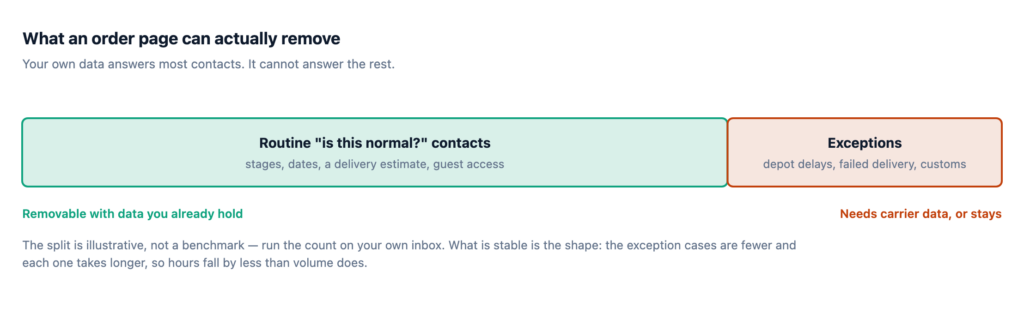
Marketing copy for this category tends to imply WISMO can be eliminated. It cannot, and the reason is structural.
Without carrier data, the best you can show is your information: when it was paid, when it was packed, when you handed it over, and when you expect it to arrive. That covers the routine questions, which are most of them.
It does not cover the parcel sitting in a depot, the failed delivery attempt, the customs hold, or the courier who marked something delivered and left it with a neighbour. Those are the cases where a customer is most likely to contact you, and where no amount of order-page work helps, because your store genuinely does not know.
A fair expectation: you can remove most of the routine “is this normal?” contacts. The exception cases stay, and they are the ones that take the longest to handle. So a substantial reduction in volume, and a smaller reduction in hours than the volume drop suggests.
One week, one tally, four categories. If WISMO turns out to be two hours a month for you, do the one-hour fix and stop. If it is a working week, it is worth doing properly.
The same exercise usually surfaces something else: WISMO is the loudest category, but it is rarely the most urgent one. Sorting a month of your inbox into four buckets is the version of this audit that tells you what to fix first.