

WPMake

← Back to BlogHandling Order Cancellations During Flash Sales Without Losing Your MindUSE CASES

Handling Order Cancellations During Flash Sales Without Losing Your Mind

⏱ 5 min read  ·  👤 david  ·  Sep 1, 2026

Flash sales bring in orders fast, and cancellations arrive on the same curve about forty minutes behind them. Mis-taps, duplicate orders and plain buyer’s remorse all spike together, usually while you are busy watching the sale itself.

None of that is avoidable. What is avoidable is handling it one email at a time. Here is what to change before the sale starts, and how to work the surge when it lands.

Why cancellations spike during sales

  • Urgency produces impulse, and impulse produces second thoughts. A countdown that made the purchase feel obvious at 9:02 makes it feel questionable at 9:40.
  • Mobile mis-taps. Sale traffic skews heavily to phones, and a crowded sale page produces duplicate and wrong-variant orders at a rate normal traffic never does.
  • Cart-total regret. Customers add more than they meant to because everything is discounted, then look at the total in the confirmation email.

The predictable shape is useful: most requests arrive inside the first hour or two, not spread across the day. Plan for a burst, not a trickle.

Tighten eligibility before the sale, not during it

The instinct is to shorten the cancellation window for sale days. In Post-Purchase Hub there is no timer to shorten — eligibility is driven by Cancellable statuses on the Actions tab, a set of checkboxes over your WooCommerce statuses. Your lever is that list, not a clock.
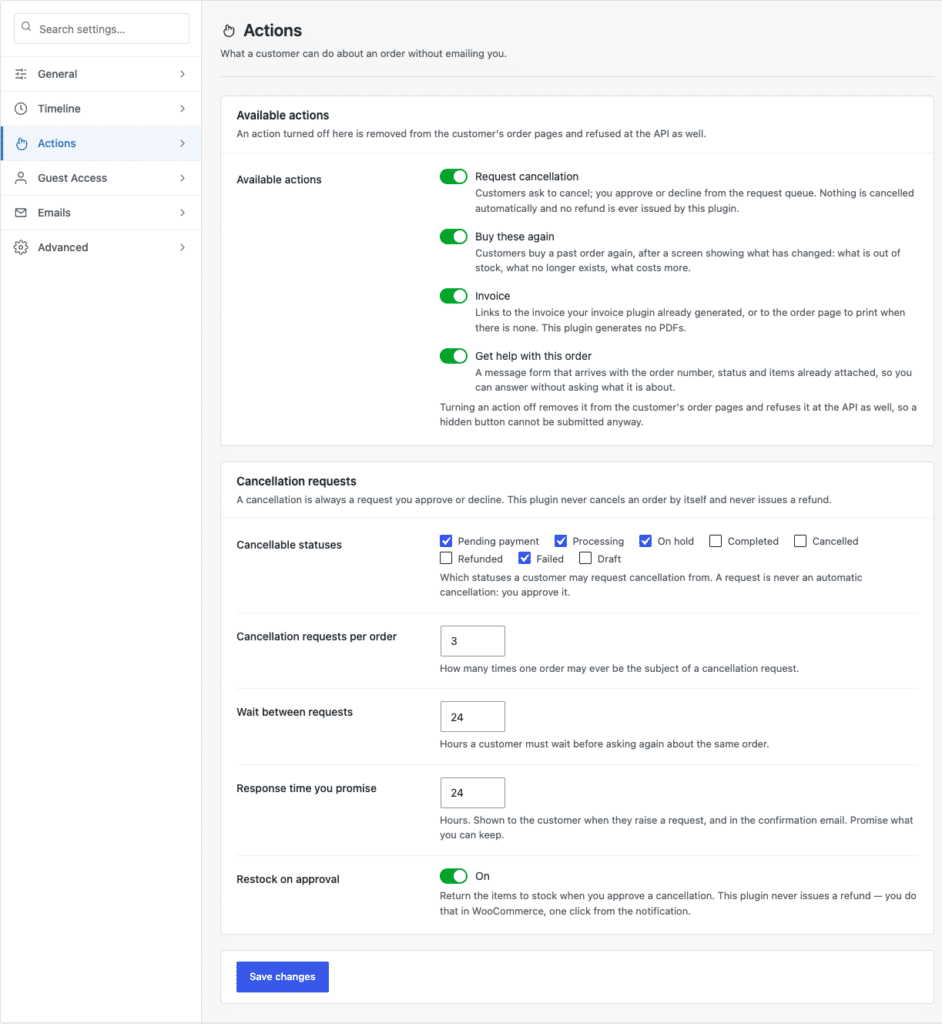
Post-Purchase Hub Actions settings showing cancellable statuses, cancellation requests per order, wait between requests, response time you promise and restock on approval
The status checkboxes are the lever. Narrow them for the sale, widen them again afterwards.

Three adjustments worth making the day before:

  1. Narrow the cancellable statuses. If you normally tick Pending payment, Processing and On hold, consider dropping Processing for the sale period — during a rush orders reach Processing within minutes, and a request on a picked order is one you will decline anyway.
  2. Drop Cancellation requests per order to one. Repeat submissions are common when customers are anxious and the site is slow, and each one adds a row to a queue you are trying to scan quickly.
  3. Set Response time you promise to your sale-day reality. The field is in hours and the number appears in the customer’s dialog and confirmation email. If you normally say four and will realistically manage twenty-four, say twenty-four — an unmet promise generates a follow-up; an honest one does not.

Treat all three as temporary and write the original values down before you change them. The settings screen has a Search settings… box that filters as you type, so putting them back afterwards takes a minute. Your normal cancellation rules should return the moment the rush is over.

Raise your handling time too

This one gets forgotten and causes more support email than the cancellations do. Your delivery estimate is calculated from Handling time in business days, and a sale that triples your order volume does not triple your picking capacity.

If picking takes two days during a sale, set handling time to two days for the sale period — or use Handling time per shipping method if only some methods are affected. A visible, honest estimate on the order timeline is what stops the second wave: the “when will this actually ship?” messages that arrive two days after the cancellations.
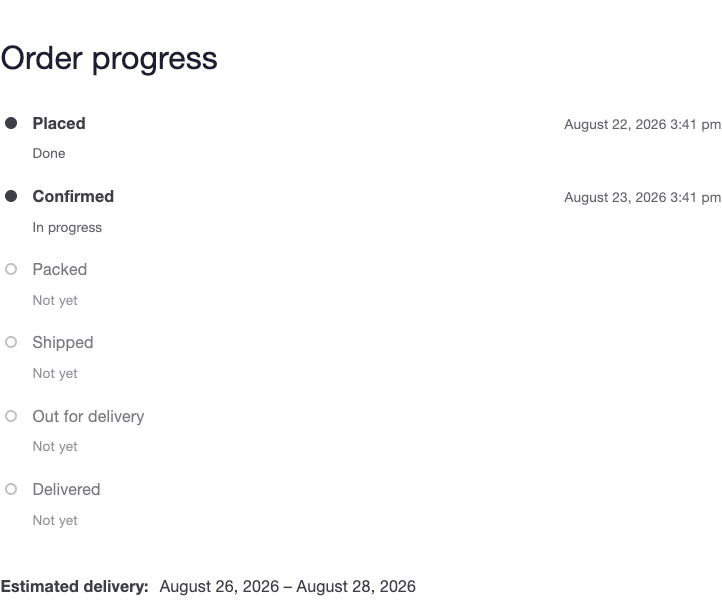
Front-end order progress timeline with stage sub-labels and an estimated delivery date range
An honest sale-week estimate prevents the second wave of messages two days later.

Work the queue in batches

Requests land at WooCommerce → Requests, with a count in the menu of everything waiting on you. During a sale this is the entire advantage: one screen with All types and All statuses filters, sortable columns, and Approve or Decline on each pending row.
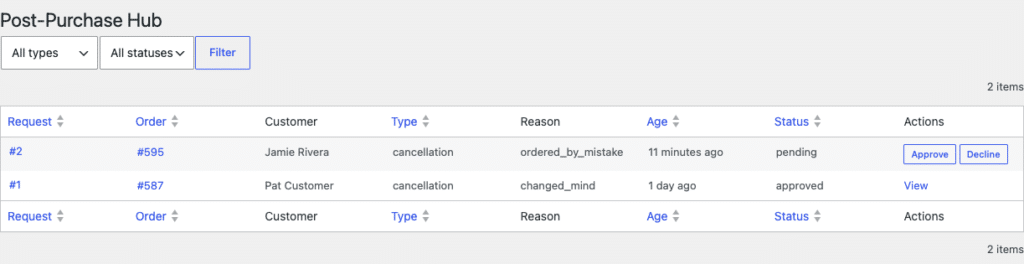
Post-Purchase Hub request queue with type and status filters, sortable columns and approve or decline actions on each row
Sorting by Age puts the oldest pending request at the top — which is the only order worth working in a rush.

A rhythm that holds up under volume:

  • Do not touch the queue during the first hour. Watch the sale. Requests are timestamped and the customer has already been told your response time.
  • Then clear it in passes, sorted by age. Duplicate orders from the same customer are the easy bulk — approve, restock, move on.
  • Approve before picking, decline after. The status tells you which, without opening the order.
  • Use the internal note on anything odd. It is never shown to the customer, and during the post-sale reconciliation it is the only record of why you decided what you did.

If you were hoping to skip the review entirely, the honest answer on auto-approval explains why the plugin will not decide these for you — and why narrowing the status list does more for your workload than an approval rule would have.

Check restock on approval before you start

With Restock on approval switched on, every approved cancellation returns items to stock immediately. During a sale that is usually what you want — the stock goes back on sale while the sale is still running. It is only wrong if you reconcile inventory by hand, in which case a burst of approvals will quietly inflate your counts.

Either way, remember that refunds are separate. Approving changes the order status; the refund is still done in WooCommerce, one click from the notification. Budget time for that after the rush — it is the step most likely to be forgotten in the noise.

After the sale ends

  1. Put the cancellable statuses back to your normal list
  2. Restore Cancellation requests per order and Response time you promise
  3. Drop handling time back to its usual value
  4. Clear any remaining queue items before they age past your promise
  5. Process the refunds for everything you approved
  6. Read the stored reasons — a sale is the best sample you will get all year on why people cancel

That last one is worth twenty minutes. Sale cancellations cluster around fixable causes far more often than normal ones do: a variant picker that confuses on mobile, a discount that reads ambiguously, a shipping cost that only appears at checkout.

Handling Order Cancellations During Flash Sales Without Losing Your Mind